If you’ve ever said “I weigh 60 kg,” you’re not alone—most of us use mass and weight like they’re the same thing. But in physics, they’re not. Once you see the logic, the difference between mass and weight becomes one of those “ohhh, that makes sense” topics.
Let’s break it down in a clean, exam-friendly way—with examples, a comparison table, and the classic “write any 5 difference between mass and weight” style answer.
Quick idea (in one line)
- Mass = how much matter an object has
- Weight = how strongly gravity pulls that mass
That’s the whole weight–mass difference in a nutshell.
What is Mass?
Mass is the amount of matter in an object. It doesn’t care where you are—Earth, Moon, or space.
- Measured in kilograms (kg) or grams (g)
- Stays the same everywhere
- Related to how hard it is to push or stop an object (inertia)
So when we talk about the “mass of a book” or “mass of a person,” we’re talking about something that doesn’t change with location.
What is Weight?
Weight is the force you feel because gravity is pulling you down.
- Measured in newtons (N) (because it’s a force)
- Changes depending on gravity
- On places with weaker gravity, your weight becomes less
That’s why astronauts feel “light” on the Moon—same mass, less gravitational pull.
Difference Between the Mass and Weight in Physics
This is the most important part if you’re aiming for a clean science answer.
The key formula (weight and mass relation)
Weight (W)=Mass (m)×Gravity (g)
- m = mass (kg)
- g = gravitational acceleration (about 9.8 m/s² on Earth)
- W = weight (newtons)
So if gravity changes, weight changes—even though mass stays constant.
Difference Between Mass and Weight With Example
Let’s use a simple example to explain the difference between mass and weight.
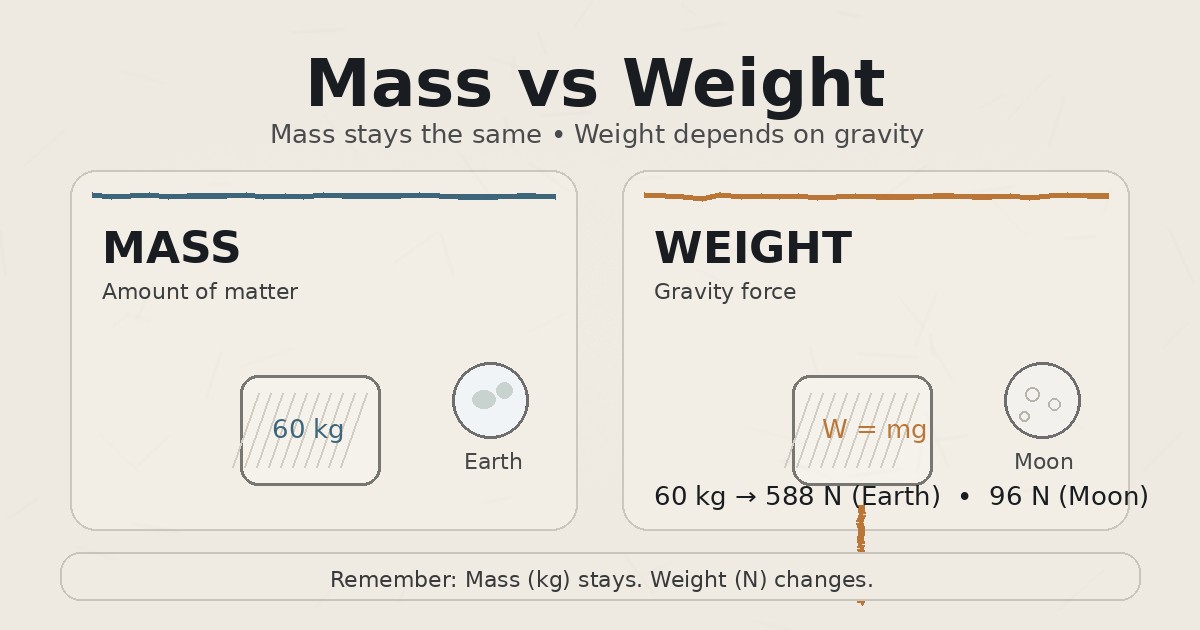
Imagine a person with a mass of 60 kg.
On Earth:
- W=60×9.8=588N
- Weight ≈ 588 N
On the Moon (gravity ≈ 1.6 m/s²):
- W=60×1.6=96N
- Weight ≈ 96 N
✅ The mass is still 60 kg in both places.
✅ The weight changes because gravity changes.
This is the easiest way to distinguish between mass and weight without memorizing anything.
Compare Mass and Weight (Simple Table)
Here’s a quick way to compare mass and weight side by side:
| Point | Mass | Weight |
|---|---|---|
| Meaning | Amount of matter | Gravitational force on mass |
| Depends on gravity? | No | Yes |
| Changes with place? | No | Yes |
| Unit | kg, g | N |
| Measured by | Balance | Spring balance |
| Nature | Scalar quantity | Vector quantity (has direction) |
If someone asks “mass and weight difference between them,” this table is a clean answer.
Write Any 5 Differences Between Mass and Weight
If your exam asks: “write the difference between mass and weight” or “write any 5 difference between mass and weight”, you can write these:
- Mass is the amount of matter; weight is the force due to gravity.
- Mass does not change with place; weight changes from place to place.
- Mass is measured in kg; weight is measured in newton (N).
- Mass is a scalar; weight is a vector (acts downward).
- Mass is measured by a beam balance; weight is measured by a spring balance.
That’s a solid 5-mark answer in most Class 10/SSC style questions too.
Why People Mix Them Up (and how to stop)
In daily life, we often say “weight” when we mean “mass,” mainly because bathroom scales show kg. But technically, those scales are using your weight to estimate your mass (assuming Earth’s gravity).
A good trick:
- If it’s in kg, you’re usually talking about mass
- If it’s a pulling force (gravity), it’s weight
FAQ
Is mass the same as weight?
No. The difference in mass and weight is that mass is constant, but weight depends on gravity.
Can weight be zero?
Yes—if gravity is effectively zero (like deep space), your weight can be nearly zero, but your mass stays the same.
What is the SI unit of mass and weight?
Mass: kilogram (kg)
Weight: newton (N)
Why do we say “I weigh 60 kg” then?
In everyday language, people say weight, but in physics that number in kg refers to mass.
What’s the easiest way to differentiate mass and weight?
Remember: Weight = mass × gravity. If gravity changes, weight changes.
Conclusion
The difference between mass & weight is simple once you link it to gravity. Mass is what you have (matter), and weight is what gravity does to you (force). So the next time someone asks “between mass and weight, which changes with place?” you’ll confidently say: weight changes, mass doesn’t—and you can even explain it with W=mg.
Leave a Comment