If you’ve ever heard someone say, “That’s socialist!” or “That’s communist!” during an argument—welcome to the club. These words get thrown around like labels in a debate, but they actually describe two different political and economic ideas.
So what’s the truth? The difference between socialism and communism is real, but it’s also easy to misunderstand because people often mix up the ideas, the movements, and the governments that claimed the labels.
Let’s unpack it clearly—without the textbook headache.
Quick overview: socialism vs communism
Here’s the simplest way to start:
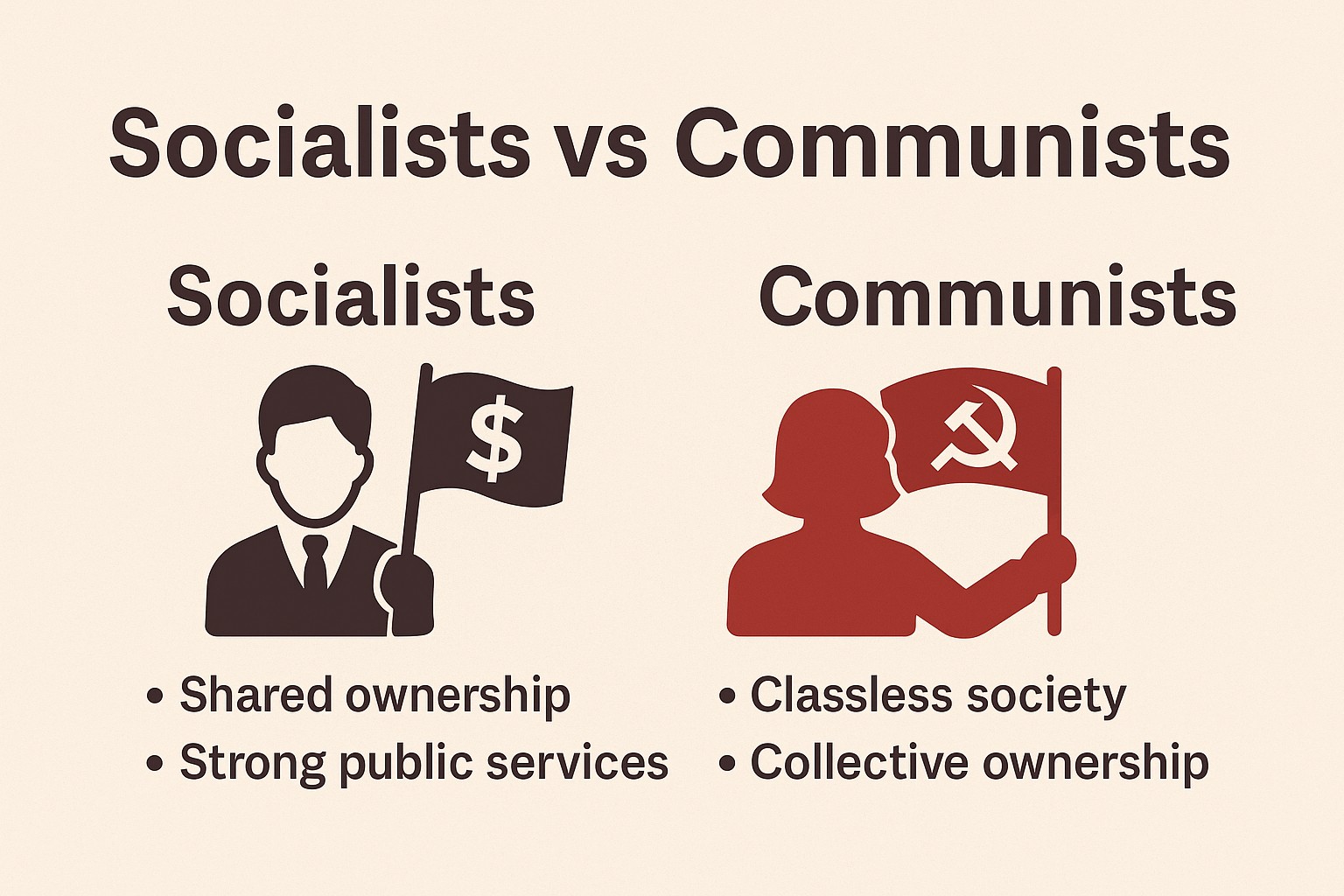
- Socialism: focuses on reducing inequality by giving society (often through the state, cooperatives, or public systems) more control over key services and parts of the economy.
- Communism: aims for a classless society where major property and production are collectively owned, and the idea of “worker vs owner” disappears.
That’s the heart of the communism and socialism differences.
What is socialism?
Socialism is a broad umbrella. Different socialists disagree on details, but most share a core goal: make the economy fairer and reduce extreme inequality.
What socialism often supports
- Strong public services (healthcare, education, social safety nets)
- More worker power (unions, worker protections)
- Public or cooperative ownership of some key industries (varies by ideology)
- Rules that limit exploitation and create a more balanced system
Some forms of socialism still accept markets and private businesses, just with more regulation and public protections.
This is why the communism socialism difference isn’t only “one is extreme, one is mild.” It’s more about the end goal and ownership structure.
What is communism?
Communism is usually described as a more radical end goal: a society with no social classes and collective ownership of the means of production (factories, land, major industries).
What communism aims for (in theory)
- No wealthy “owner class” controlling production
- No exploitation of workers by owners
- A system where resources are distributed according to need
- In classic theory, the state eventually becomes unnecessary (because class conflict disappears)
In real life, many governments that called themselves communist did not match the “textbook” ideal, which is part of why debates get heated fast.
Socialists vs communists: what’s the main difference?
If someone asks, “what is the main difference between communism and socialism?” here’s a clean answer:
The key difference
- Socialism usually allows some private property and markets, while pushing for stronger public control and fairness.
- Communism pushes toward collective ownership of production with the goal of a classless society.
That is the core difference between communism & socialism most people mean.
Difference between a socialist and a communist
Now let’s talk about people, because “systems” and “supporters” get mixed up.
A socialist (generally)
A socialist typically believes society should reduce inequality through:
- public services,
- worker protections,
- and shared or public ownership of some important sectors.
They may still support elections, markets, and private businesses—depending on the type of socialism.
A communist (generally)
A communist typically believes capitalism creates permanent class conflict and that society should move toward:
- collective ownership of production,
- and eventually a classless, stateless society (in theory).
So, the difference between a socialist and a communist often comes down to how far they think society should transform, and how quickly.
Comparison chart: socialism vs communism
Here’s a quick chart that answers what’s the difference between socialism and communism at a glance:
| Topic | Socialism | Communism |
| Goal | Reduce inequality, increase fairness | Classless society |
| Ownership | Mix of public/co-op + private (varies) | Collective ownership of major production |
| Markets | Often allowed (regulated) | Typically minimized or eliminated (in theory) |
| Private property | Often allowed, with limits | Major private ownership of production rejected |
| How it’s discussed today | Wide range of ideas | Usually treated as more radical end goal |
Is socialism and communism the same?
People ask this a lot: is socialism and communism the same?
Short answer: No.
Longer (but still simple) answer: socialism is a broad category with many versions, while communism is usually described as a more complete break from private ownership of production, aiming for a classless society.
So if you’re asking:
- are socialism and communism the same thing? → not really
- is socialism the same as communism? → no, though they share some criticisms of capitalism
Social democracy vs communism (quick clarity)
This one matters because many people confuse social democracy with socialism.
Social democracy (in everyday politics)
Social democracy usually means:
- a capitalist economy (private businesses, markets),
- plus strong welfare programs, labor rights, and regulation.
Communism
Communism aims for a system where major production is collectively owned and class divisions disappear (in theory).
So social democracy vs communism is basically: reform capitalism with strong protections vs replace the ownership model entirely.
Difference between capitalism and communism and socialism
If you want the clean “three-way” comparison:
- Capitalism: private ownership + markets drive production; profits and competition play a big role.
- Socialism: more shared/public control in key areas + stronger worker protections; markets may still exist.
- Communism: collective ownership of production; aims to remove class divisions (in theory).
That covers the common search: difference between capitalism communism and socialism.
A simple real-life example (no politics needed)
Imagine a city has one big bus company:
- Under capitalism, a private company owns it, sets prices, and runs it for profit (with regulations depending on the country).
- Under socialism, the city or workers might run the bus service as a public service, focusing on affordability and access.
- Under communism (in theory), transportation is collectively managed as part of a system where major services and production aren’t privately owned.
Same bus system—different ownership goal and purpose.
FAQ: Socialists vs Communists
What is the difference between socialism and communism?
Socialism typically focuses on reducing inequality through shared/public systems and may still allow markets and private property. Communism aims for collective ownership of production and a classless society (in theory).
What’s the difference between communist and socialist (people)?
A socialist usually supports reforms that increase fairness and shared benefits, sometimes within markets. A communist usually supports moving toward collective ownership of production and deeper structural change.
Are communism and socialism the same thing?
No. They overlap in criticizing capitalism, but socialism is broader and often works with mixed economies, while communism aims for a more complete collective ownership model.
What’s the difference between socialism and communism in one sentence?
Socialism is often about sharing more within society; communism is about eliminating class ownership of production (in theory).
Conclusion
The debate around socialists vs communists gets messy because people use the words as insults, not definitions. But the clean idea is this: socialism usually aims to make society fairer through stronger public systems and shared benefits (often alongside markets), while communism aims for collective ownership of production and a classless society. Once you separate the ideas from the labels, the difference becomes much easier to understand.
Leave a Comment