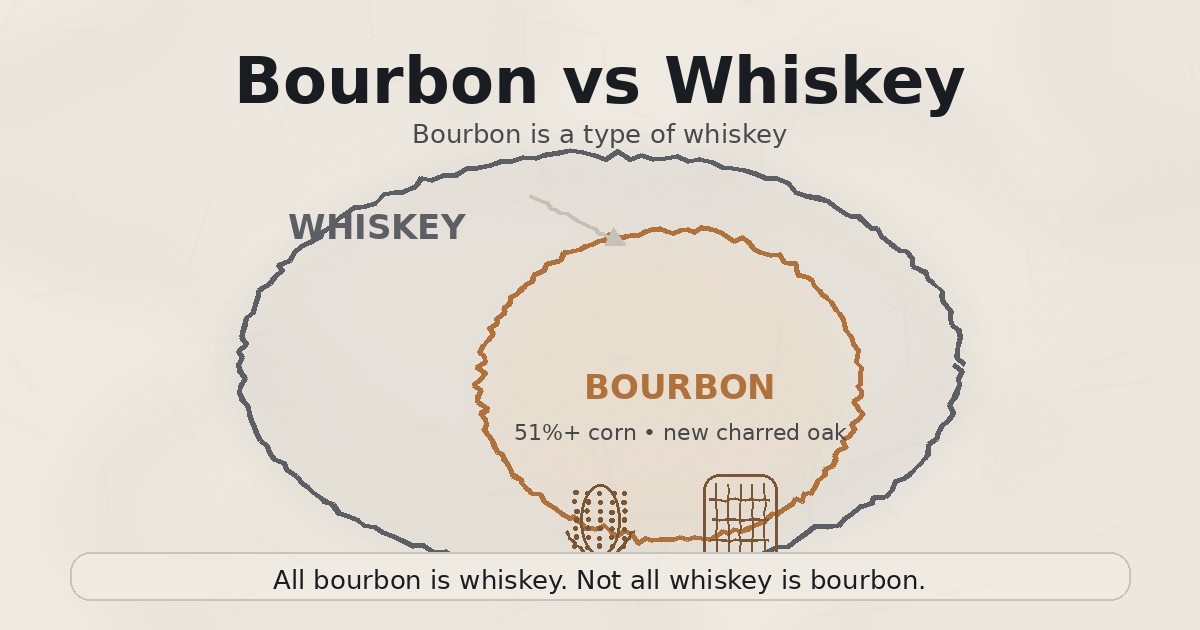
If you’ve ever been at a bar (or staring at a store shelf) trying to decide between bourbon and whiskey, you’ve probably asked the same question everyone asks: bourbon versus whiskey—what’s actually different?
Here’s the “aha” moment that clears it up:
Whiskey is the big category. Bourbon is one specific style inside it.
Once you know that, the rest—taste, labels, and why some bottles cost more—starts to make a lot more sense.
The quick answer: bourbon is whiskey (but not all whiskey is bourbon)
When people search bourbon vs whiskey, they’re usually expecting two separate things. But it’s more like this:
- Whiskey = the family name
- Bourbon = one family member with a strict set of rules and a recognizable flavor
So the bourbon vs whiskey difference is mostly about definition and how it’s made.
What is whiskey?
Whiskey (or whisky) is a distilled spirit made from fermented grains and aged in barrels. The grain could be:
- corn
- rye
- wheat
- barley
- or a blend
That’s why whiskey can taste wildly different depending on style and origin—spicy, smoky, sweet, malty, fruity… the range is huge.
If you’re comparing whisky vs whiskey vs bourbon, think of “whiskey/whisky” as the umbrella term, and bourbon as one specific type underneath it.
What is bourbon?
Bourbon is a whiskey with stricter rules (especially under U.S. labeling standards). The two details most people notice first are:
- It’s corn-forward (at least 51% corn)
- It’s aged in new, charred oak barrels
That combination is why bourbon often tastes like vanilla, caramel, toasted oak, and warm sweetness.
Why bourbon tastes “sweeter”
Corn naturally brings a softer sweetness compared to rye or barley-heavy whiskeys. And new charred oak barrels add big flavor—think toasted wood, vanilla-like notes, and rich spice.
This is the most practical “taste version” of the difference between bourbon and whiskey.
Difference between bourbon and whiskey (simple chart)
Here’s a clean comparison that answers difference between bourbon & whiskey fast:
| Feature | Whiskey | Bourbon |
|---|---|---|
| What it is | A broad category of aged grain spirits | A specific type of whiskey |
| Main grain | Can be corn, rye, barley, wheat, etc. | At least 51% corn |
| Barrels | Varies widely | New, charred oak barrels |
| Flavor range | Very wide | Often sweeter, oak-forward |
| Label rules | Depends on style and region | More specific requirements |
So if you’ve ever wondered difference between a bourbon and a whiskey, the simplest answer is: bourbon is whiskey with a stricter recipe and aging rules.
Bourbon whiskey vs whiskey (and “bourbon whiskey vs bourbon”)
You’ll see people search bourbon whiskey vs whiskey and even bourbon whiskey vs bourbon.
In everyday life:
- “Bourbon” and “bourbon whiskey” usually mean the same thing.
“Bourbon whiskey” is often just a more formal label, not a different product. So if you’re asking what’s the difference between bourbon and bourbon whiskey, most of the time the answer is: there isn’t one.
“Whisky” vs “whiskey” (spelling, simplified)
The spelling can look like another debate, but it’s usually just tradition:
- Whiskey is common in the U.S. and Ireland
- Whisky is common in Scotland, Canada, and Japan
This is why you’ll see searches like bourbon whisky vs whiskey. Bourbon is typically labeled “whiskey” in the U.S., but the spelling itself isn’t the main difference—how it’s made is.
Rye whiskey vs bourbon (quick, useful comparison)
If bourbon feels sweet and cozy, rye often feels punchy and spicy.
Rye whiskey
- rye-heavy grain recipe
- usually tastes spicier, drier, peppery
- great if you like bold cocktails
Bourbon
- corn-forward grain recipe
- often tastes sweeter, richer, vanilla/oak
- great if you want a smooth sipper
If you’re stuck between rye whiskey vs bourbon, this is the fastest way to choose based on your taste.
Which should you buy? (a real-world guide)
Here’s a simple way to decide without overthinking:
Choose bourbon if you want:
- a smoother, sweeter profile
- vanilla/caramel/oak flavors
- easy sipping, especially as a beginner
- classic cocktails like an Old Fashioned
Choose other whiskeys if you want:
- more spice (often rye-forward)
- smoke (some Scotch styles)
- lighter profiles (some Irish styles)
- a wider range of flavors overall
Honestly, the best move is to try one pour of each style once. Your taste buds will settle the debate faster than any chart.
FAQ: Bourbon vs Whiskey
What’s the difference between bourbon and whiskey?
The difference between bourbon and whiskey is that bourbon is a specific type of whiskey made with at least 51% corn and aged in new, charred oak barrels. Whiskey is the broader category that includes bourbon and many other styles.
What’s the difference between a bourbon and a whiskey in taste?
Bourbon often tastes sweeter and more oak-forward (vanilla/caramel notes), while whiskey in general can taste spicy, smoky, malty, or light depending on style.
What’s the difference between bourbon whiskey and whiskey?
Bourbon whiskey vs whiskey is basically “one style vs the whole category.” Bourbon is one kind of whiskey with stricter rules; whiskey includes many styles beyond bourbon.
What’s difference between whiskey and bourbon—are they different strengths?
Either can be strong or mild. Proof depends on the specific bottle, not whether it’s bourbon or another whiskey.
Rye whiskey vs bourbon: which is better for cocktails?
If you want spice and bite, rye is excellent. If you want a sweeter, rounder drink, bourbon is a classic choice.
Conclusion
The difference between bourbon and whiskey is simple once you see the big picture: bourbon is whiskey with specific rules, especially the corn-heavy recipe and new charred oak aging. That’s why bourbon often tastes sweeter and richer, while whiskey overall covers a massive range of flavors and styles. If you like warm vanilla-oak sweetness, start with bourbon. If you want variety, explore the wider whiskey world.
Leave a Comment