If you’ve ever stared at an application form that says “Upload your CV” and thought, Wait… do they mean my resume?—you’re not alone. The cv vs resume confusion is one of the most common job-search headaches, especially because different countries use the words differently.
Here’s the good news: once you understand the purpose of each document, the difference between CV and resume becomes super easy.
Quick answer in one line
A resume is a short, targeted highlights sheet for a job.
A CV (curriculum vitae) is a detailed, full record of your academic/professional journey.
That one idea can help you instantly spot the cv or resume difference.
What is a resume?
A resume is your “best-of” document. It’s built to answer one question:
“Why are you a good fit for this specific role?”
What a resume usually includes
- A short summary (optional, but helpful)
- Skills related to the job
- Work experience (bullet points with results)
- Education
- Certifications, projects, achievements (selected, not everything)
Resume length and style
Most resumes are 1 page (or 2 pages if you have strong experience). The key is focus: you cut anything that doesn’t support the job you’re applying for.
This is why people often say the resume v curriculum vitae choice depends on what the employer wants and what field you’re in.
What is a CV (curriculum vitae)?
A CV—short for curriculum vitae—is more like a full timeline of your academic and professional life. Think of it as “everything relevant” rather than “only the highlights.”
What a CV usually includes
- Education (often detailed)
- Research experience
- Publications, conference papers, presentations
- Teaching experience
- Grants, awards, scholarships
- Certifications, trainings, professional memberships
- Projects (more complete list than a resume)
CV length and style
A CV can be 2 pages, 5 pages, or even longer—because it’s meant to be comprehensive, not minimal.
If you’ve been comparing curriculum vitae vs resume, this “detail level” is the biggest difference.
Small note: people sometimes misspell curriculum vitae as “circum vitae.” If you’ve typed circum vitae vs resume before, don’t worry—everyone does it once!
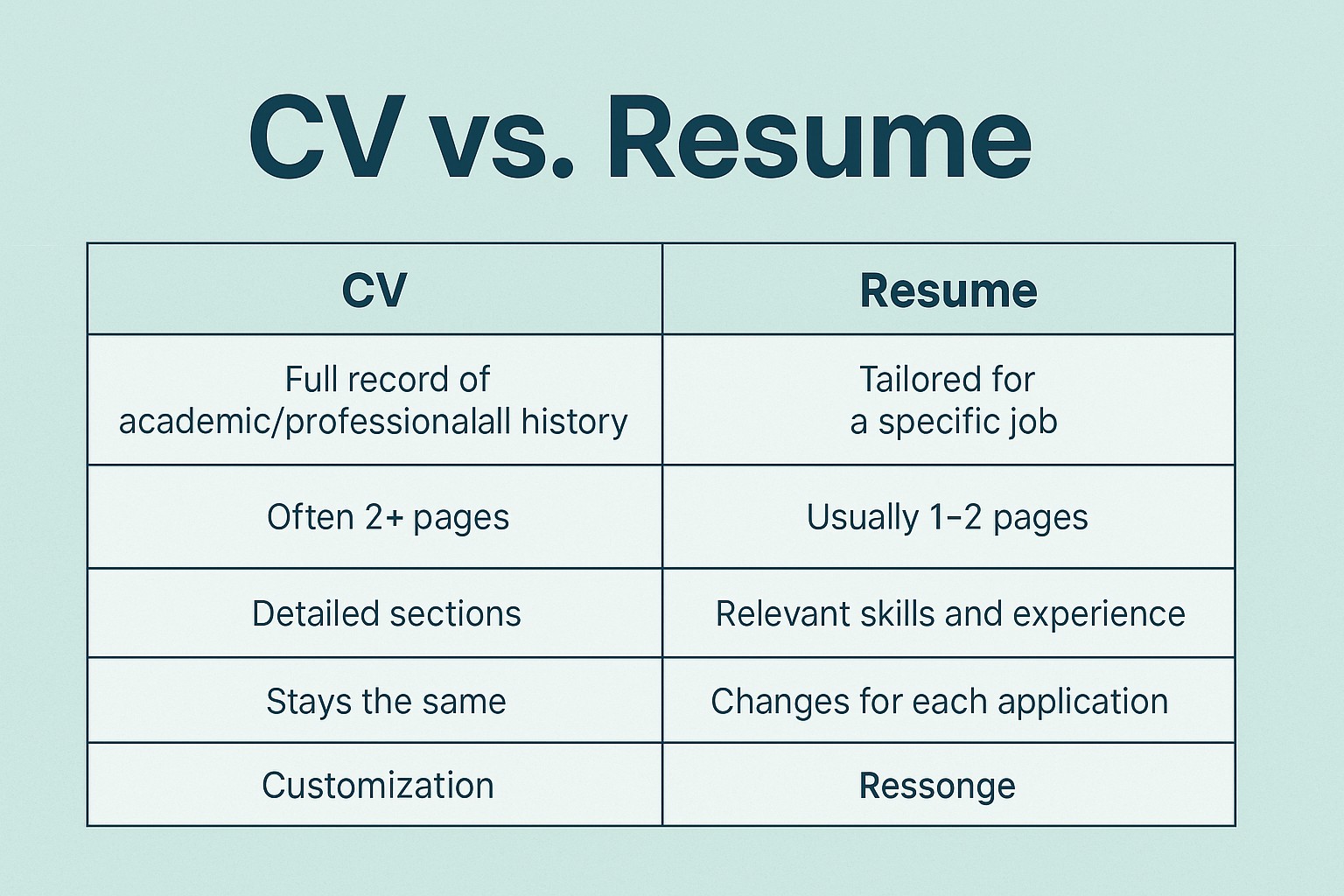
Difference between CV and resume (comparison chart)
Here’s a simple CV versus resume chart you can use for quick decisions:
| Feature | Resume | CV (Curriculum Vitae) |
| Purpose | Tailored to one job | Full academic/professional record |
| Length | Usually 1–2 pages | Often 2+ pages (can be long) |
| Best for | Most jobs in industry | Academia, research, grants, teaching |
| Content style | Highlights + results | Detailed sections + full history |
| Customization | Changes for each job | Updates over time, less job-specific |
| Focus | Skills + impact | Credentials + contributions |
This table basically answers any version of: difference between cv & resume, difference between resume & cv, or difference between resume & curriculum vitae.
CV curriculum vitae vs resume: which one should you use?
This is the part that actually helps in real life.
Use a resume when…
- You’re applying for most corporate/industry jobs
- The application says “resume” (common in the U.S. and many employers)
- You need to keep it short and targeted
Use a CV when…
- You’re applying for academic roles (lecturer, professor, researcher)
- You’re submitting for scholarships, grants, fellowships
- The institution specifically asks for a CV or “curriculum vitae”
What about “curriculum vitae or resume” on the form?
If it says “curriculum vitae or resume”, it usually means: submit whichever is standard for your field.
For industry roles, send a resume. For academic/research roles, send a CV.
That’s the real-world meaning behind curriculum vitae or resume difference.
Vitae vs resume (and “vita vs resume”): are they different?
“Vitae” is just the Latin word used inside “curriculum vitae.” So when people search vitae vs resume or vita vs resume, they’re basically asking:
“CV vs resume—what’s the difference?”
And the answer stays the same: CV = detailed record, resume = targeted summary.
Is CV and resume the same?
Short answer: not usually.
But here’s the honest nuance:
- In the U.S., a CV and a resume are typically different documents.
- In some countries (and many informal conversations), people use “CV” to mean “resume.”
So if you’re asking is cv and resume the same or is cv and resume same, the safest move is to follow what the employer asks and match the expected format for that country/industry.
Common mistakes people make (and how to avoid them)
1) Sending a long CV for a normal job
Hiring managers for industry roles often want speed. If they asked for a resume, give a resume.
2) Treating a resume like a biography
A resume isn’t your life story—it’s your best proof for this role.
3) Not tailoring the resume
Even small changes (skills order, job keywords, bullet emphasis) can improve results.
4) Forgetting that formatting is part of “communication”
Clear headings, simple fonts, and strong spacing make you look professional instantly.
FAQ (CV vs Resume)
What is the difference between CV and resume?
The difference between CV and resume is mainly detail and purpose: a resume is short and job-targeted, while a CV (curriculum vitae) is longer and includes a fuller academic/professional history.
Differentiate between a CV and a resume in 3 points
- Length: resume is short; CV is longer
- Use: resume for most jobs; CV for academia/research
- Content: resume = highlights; CV = detailed record
Difference between resume and vitae—what does “vitae” mean?
“Vitae” is part of “curriculum vitae.” So difference between resume and vitae usually means CV vs resume: CV is more detailed; resume is more targeted.
CV v resume: which is better?
Neither is “better.” The better one is the one the employer expects. If the role is academic, a CV wins. If it’s a standard job posting, a resume usually fits best.
Conclusion
The cv vs resume decision gets easy when you stop thinking of them as the same document. A resume is your focused highlights for a specific job. A CV (or curriculum vitae vs resume) is your complete record, especially useful for academic, research, and scholarship paths. Match the document to the role—and you’ll instantly look more professional.
Leave a Comment