If “affect” and “effect” keep messing with your confidence while writing, you’re not alone. They look similar, sound similar, and even show up in the same kinds of sentences. But once you learn one simple rule (and two small exceptions), the difference between affect and effect becomes surprisingly easy.
This guide will help you understand the difference between affect & effect, show you real examples, and give you quick memory tricks you can use in exams, emails, and everyday writing.
The One-Sentence Rule (Most of the Time)
In most sentences:
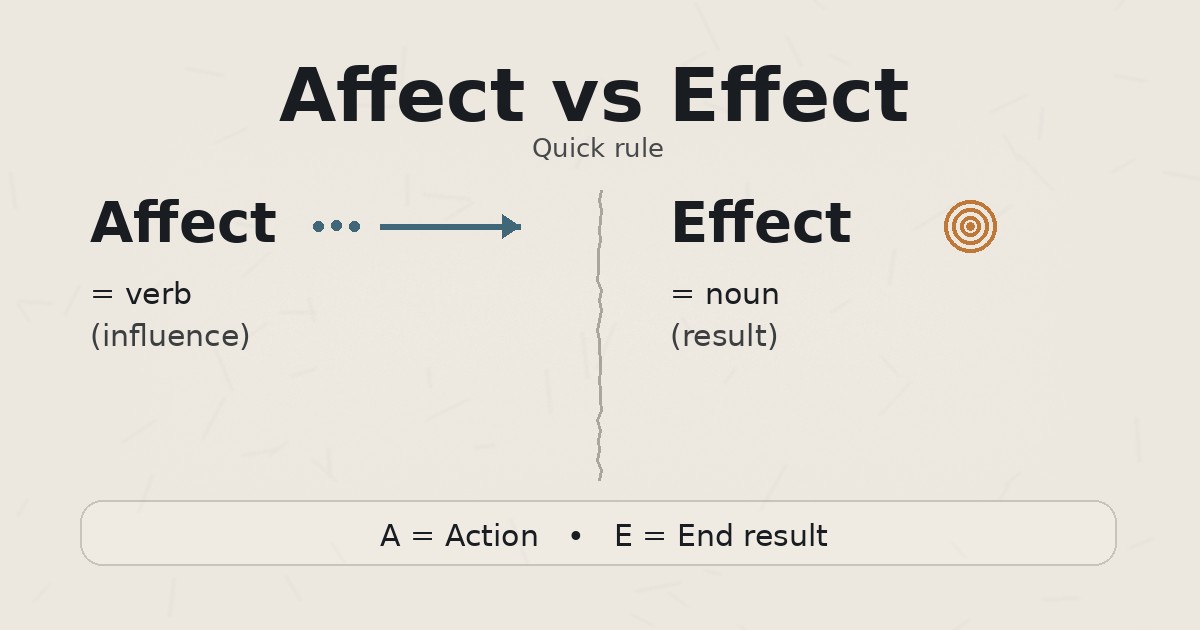
- Affect = a verb (to influence)
- Effect = a noun (a result)
That’s the core affect difference effect rule.
Quick examples
- The weather affected our plans. (influenced = verb)
- The weather had a big effect on our plans. (result = noun)
If you remember just this, you’ll handle 90% of situations correctly.
What Does “Affect” Mean?
Affect (Verb): to influence something
When you use affect, you’re usually saying that something changes or influences something else.
Examples
- Lack of sleep can affect your mood.
- The new rule will affect all students.
- Stress can affect your health.
So the difference affect and effect starts here: affect is usually an action.
What Does “Effect” Mean?
Effect (Noun): the result or outcome
When you use effect, you’re talking about what happened because of something.
Examples
- The medicine had a strong effect.
- The policy change had an effect on prices.
- The sound effects made the movie more dramatic. (same noun idea)
So the difference between affect & effect is often:
Affect = influence (verb), Effect = result (noun).
Difference Between Affect and Effect Examples (Side-by-Side)
Here are simple pairs you can copy as a pattern:
Example 1
- The loud noise affected my concentration.
- The loud noise had a bad effect on my concentration.
Example 2
- Pollution affects the environment.
- Pollution has a harmful effect on the environment.
Example 3
- The coach’s speech affected the team’s confidence.
- The coach’s speech had a positive effect on the team.
These kinds of difference between affect and effect examples make the rule feel automatic.
The Two Exceptions You Should Know
Most people learn the basic rule and then panic when they see an exception. Don’t worry—there are only two common ones worth remembering.
1) “Effect” as a verb (rare but real)
Effect (verb) means to bring about / to cause something to happen—often used in formal writing.
Example
- The new manager will effect major changes in the company.
(meaning: will bring about changes)
A simple tip: if “effect” can be replaced with “create” or “make happen,” it might be the verb form.
2) “Affect” as a noun (mostly psychology)
In psychology, affect (noun) can mean a person’s emotional state.
Example
- The patient showed a flat affect.
(meaning: limited emotional expression)
If you’re not writing psychology or medical notes, you’ll rarely need this.
A Memory Trick That Actually Works: RAVEN
Use this mini-mnemonic:
RAVEN
- Remember
- Affect = Verb
- Effect = Noun
When you’re stuck, think: A = Action (verb), E = End result (noun).
Common Mistakes (And How to Fix Them)
Mistake 1: Using “effect” when you need a verb
Wrong: The weather effected our travel plan.
Right: The weather affected our travel plan.
(Influence = affect)
Mistake 2: Using “affect” when you need a noun
Wrong: The new law had a big affect.
Right: The new law had a big effect.
(Result = effect)
If your sentence includes “a/an/the” before the word, it’s often a noun—so effect is usually correct.
Bonus: Difference Between Accept and Except (Quick & Clear)
Since people often confuse multiple word pairs at once, here’s a fast and helpful add-on.
Accept = to receive or agree
- I accept your invitation.
- She accepted the gift.
Except = excluding
- Everyone came except Rafi.
- The shop is open every day except Friday.
So the difference between accept and except is simple:
Accept = receive, Except = exclude.
Mini Test (Try This in Your Head)
Fill in the blank with affect or effect:
- The new schedule will ______ my routine.
- The new schedule had an ______ on my routine.
- The government hopes to ______ positive changes.
Answers:
- affect 2) effect 3) effect (verb: bring about)
FAQ
1) What is the simplest difference between affect and effect?
The simplest difference between affect and effect is: affect usually means “to influence” (verb), and effect usually means “a result” (noun).
2) Can “effect” ever be used as a verb?
Yes. In formal writing, effect can be a verb meaning “to bring about,” like “to effect change.”
3) What are some difference between affect and effect examples?
Example: “Lack of sleep affected my mood” vs “Lack of sleep had an effect on my mood.” These are classic difference between affect and effect examples.
4) Is “accept and except” related to affect and effect?
They’re different word pairs, but they’re commonly confused. The difference between accept and except is: accept = receive/agree, except = exclude.
Conclusion
The difference between affect and effect becomes easy once you remember the main rule:
Affect is usually a verb (influence), and effect is usually a noun (result).
Then just keep the two exceptions in your back pocket—effect as a verb (to bring about) and affect as a noun (emotional state, mostly psychology). With a few examples and the RAVEN trick, you’ll stop guessing and start writing confidently.
Leave a Comment