If you’ve ever wondered why your physics teacher keeps saying “speed isn’t velocity,” you’re not alone. In everyday life, people use these words like they mean the same thing. But in science, that small difference matters—especially when you’re solving problems, reading graphs, or understanding motion.
In this guide, I’ll explain the difference between speed and velocity in a friendly, easy way, with practical examples you can visualize. By the end, you’ll confidently explain the speed and velocity difference, and you’ll also understand related ideas like acceleration and flow.
What Is Speed?
Speed tells you how fast something is moving.
- It only cares about distance traveled and time taken.
- It does not care about direction.
Simple definition:
Speed = distance ÷ time
Example:
If a car travels 100 km in 2 hours, its speed is 50 km/h.
That’s it—no “north,” “south,” or “toward the school.” Just how fast.
What Is Velocity?
Velocity tells you how fast something is moving and in what direction.
- It cares about displacement (change in position) and time.
- Direction is required.
Simple definition:
Velocity = displacement ÷ time
Example:
If a car moves 100 km east in 2 hours, its velocity is 50 km/h east.
So the key idea is: velocity includes direction, speed doesn’t.
Speed and Velocity Difference (The Core Distinction)
Let’s make the speed velocity difference crystal clear:
Speed
- Scalar quantity (only magnitude)
- Depends on distance
- No direction needed
- Never negative
Velocity
- Vector quantity (magnitude + direction)
- Depends on displacement
- Direction is necessary
- Can be negative (depending on chosen direction)
If you need to distinguish between speed and velocity, remember this one-liner:
Speed is “how fast.” Velocity is “how fast + where to.”
A Real-Life Example You Can Picture
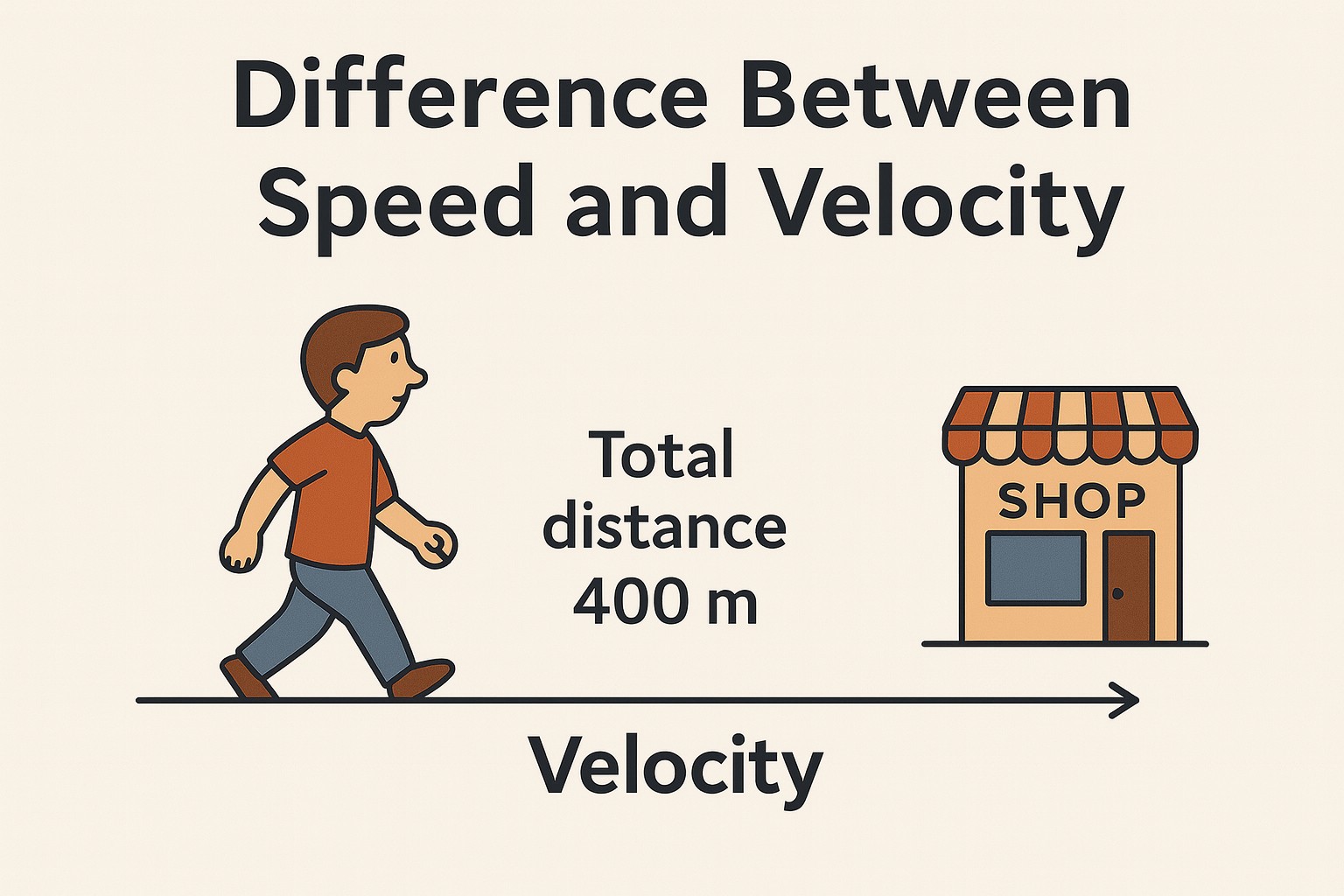
Imagine you walk from your home to a shop 200 meters east, then you come back 200 meters west to your home.
- Total distance = 200 + 200 = 400 m
- Displacement = you ended where you started = 0 m
If the whole trip took 400 seconds:
- Average speed = 400 m ÷ 400 s = 1 m/s
- Average velocity = 0 m ÷ 400 s = 0 m/s
This example is perfect for understanding the difference between average speed and average velocity.
Difference Between Average Speed and Average Velocity
People often mix these up because both use “average,” but they measure different things.
Average Speed
Average speed = total distance ÷ total time
- Uses distance
- Always zero or positive
- Doesn’t care about direction
Average Velocity
Average velocity = total displacement ÷ total time
- Uses displacement
- Can be positive, negative, or zero
- Direction matters
So, the difference between average speed and average velocity becomes obvious whenever the path includes turning back, moving in a circle, or changing direction a lot.
Quick Table: Speed vs Velocity
| Feature | Speed | Velocity |
|---|---|---|
| Type | Scalar | Vector |
| Uses | Distance | Displacement |
| Direction | Not needed | Required |
| Can be negative? | No | Yes |
| Example | 60 km/h | 60 km/h north |
Difference Between Velocity and Acceleration
Now that velocity is clear, acceleration becomes much easier.
Velocity
Tells you how fast and in what direction you’re moving.
Acceleration
Tells you how fast your velocity is changing.
That means acceleration can happen if:
- speed increases (you press the accelerator),
- speed decreases (braking),
- direction changes (turning),
even if speed stays constant.
So the difference between velocity and acceleration is:
- Velocity is motion (how fast + direction).
- Acceleration is change in motion (change in velocity over time).
Example:
A car moving at 40 km/h in a circle is accelerating because its direction keeps changing—even if the speed stays the same.
Difference Between Flow Rate and Velocity
This comes up a lot in fluid mechanics and engineering, so it’s great that you included it.
Velocity (in fluids)
Fluid velocity tells you how fast a fluid particle is moving in a direction.
- Unit: m/s
Flow Rate
Flow rate tells you how much fluid passes a point per unit time.
Two common types:
- Volumetric flow rate (Q) = volume/time
- Unit: m³/s (or L/s)
- Mass flow rate = mass/time
- Unit: kg/s
Relationship (very common formula):
Q = A × v
Where:
- Q = flow rate
- A = cross-sectional area
- v = velocity
So the difference between flow rate and velocity is simple:
- Velocity = how fast the fluid moves
- Flow rate = how much fluid moves per second
A wide pipe can have a large flow rate even if velocity isn’t very high—because the area is bigger.
Common Mistakes Students Make
1) Forgetting direction in velocity
Writing “20 m/s” as velocity without direction is incomplete.
2) Using distance instead of displacement
For velocity problems, always ask: “Where did it start and end?”
3) Thinking acceleration only means “speeding up”
Acceleration also includes slowing down and turning.
Simple Tips to Remember Everything
- Speed → “fast”
- Velocity → “fast + direction”
- Average speed → “distance/time”
- Average velocity → “displacement/time”
- Acceleration → “change in velocity”
- Flow rate → “volume/time”
FAQ
1) How do I distinguish between speed and velocity quickly?
To distinguish between speed and velocity, remember: velocity always needs direction, speed does not.
2) Can speed be zero while velocity is not zero?
No. If speed is zero, the object isn’t moving, so velocity must also be zero.
3) Can velocity be zero while speed is not zero?
Yes—especially in round trips. This is why the difference between average speed and average velocity matters: you can move and still end up where you started, giving average velocity = 0.
4) What is the difference between velocity and acceleration in one line?
The difference between velocity and acceleration is: velocity describes motion, acceleration describes the change in motion.
5) What’s the difference between flow rate and velocity in fluids?
The difference between flow rate and velocity is: velocity is speed in a direction (m/s), while flow rate measures how much fluid passes per second (m³/s). They relate by Q = A × v.
Conclusion
The difference between speed and velocity is one of those topics that feels small at first—but it becomes a big deal when motion changes direction. Speed measures how fast something moves, while velocity measures how fast it moves and where it’s going.
Once you understand distance vs displacement, the speed and velocity difference becomes easy. And from there, topics like the difference between velocity and acceleration and the difference between flow rate and velocity also start making sense naturally.
Leave a Comment