If you’re shopping for a truck, SUV, or sporty sedan, you’ve probably seen two options that create instant debate: V6 vs V8. One person says, “V8 is the real deal,” while another says, “V6 is smarter.”
And honestly? Both can be right—depending on what you need.
In this guide, we’ll break down the difference between V6 and V8 in plain English, with a simple chart and real-life examples so you can choose confidently.
Quick answer (one line)
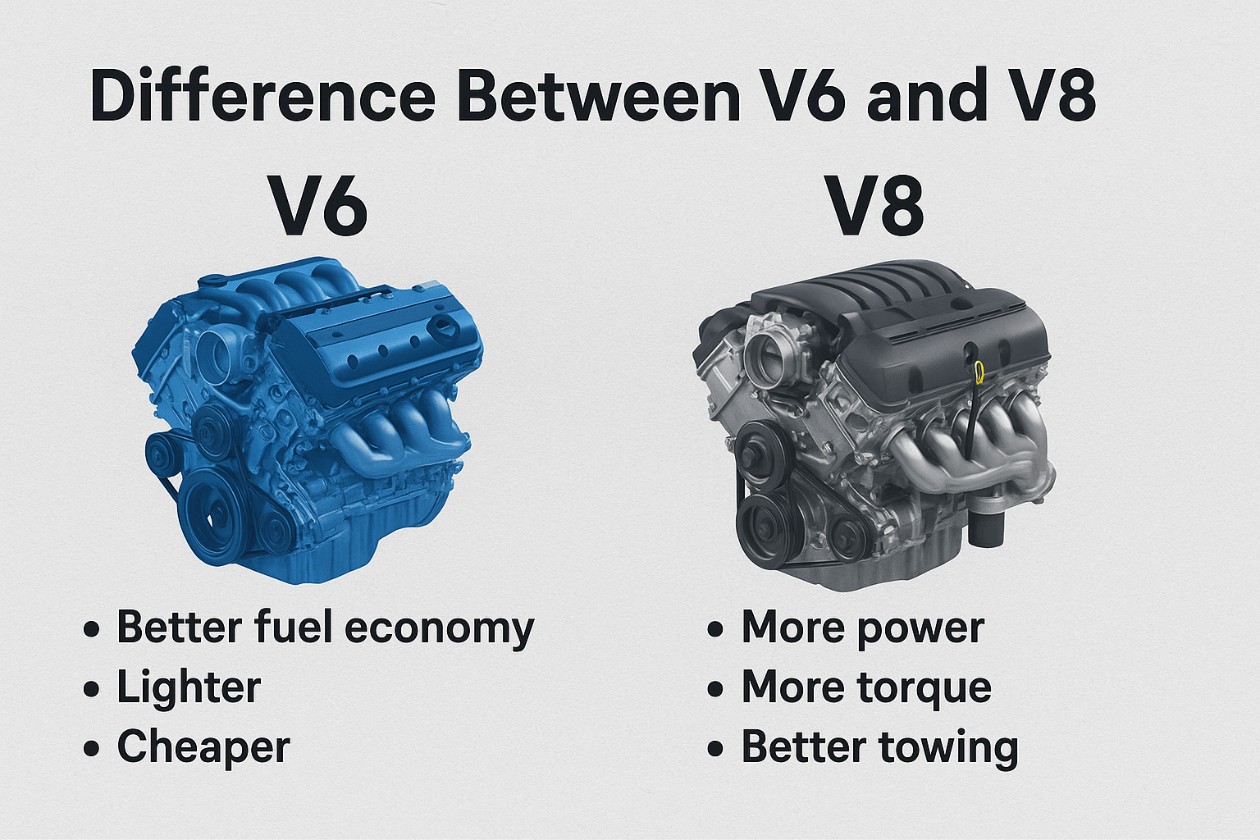
- V6 = usually better fuel economy + lighter + cheaper
- V8 = usually more power + more torque + better towing
That’s the big-picture difference between V6 and V8.
What does “V6” and “V8” mean?
The “V” describes the engine’s cylinder layout (two banks shaped like a V). The number tells you how many cylinders:
- V6 = 6 cylinders
- V8 = 8 cylinders
More cylinders often means the engine can produce more power—though modern tech (like turbocharging) can change the game.
Difference between V6 and V8 (comparison chart)
Here’s a quick chart that answers most “V6 vs V8” questions:
| Feature | V6 | V8 |
| Power (horsepower) | Good to very strong (varies) | Usually higher |
| Torque (pulling power) | Solid | Usually stronger, especially low-end |
| Towing/hauling | Capable (depending on setup) | Often better for heavy towing |
| Fuel economy | Usually better | Usually lower |
| Cost (vehicle + running) | Often cheaper | Often more expensive |
| Weight | Lighter | Heavier |
| Sound/feel | Smoother than 4-cyl, less “rumble” | Classic V8 rumble, strong feel |
| Best for | Daily driving, mixed use | Performance, towing, heavy-duty use |
The “real” differences that matter day-to-day
1) Power and acceleration
A V8 typically has more horsepower and torque, which can mean:
- quicker acceleration,
- stronger passing power,
- more confident performance under load.
But a strong V6 (especially turbocharged) can feel surprisingly fast. So the badge alone doesn’t tell the whole story.
2) Torque and towing
If you tow or haul regularly, torque matters more than horsepower.
In general:
- V8s often deliver stronger low-end torque, which feels “effortless” when towing.
- V6 engines can tow well too, but sometimes they need higher RPMs (and may feel busier).
If towing is your main reason for buying, a V8 often makes life easier—especially with heavy trailers.
3) Fuel economy and running cost
This is where many people lean V6.
- V6 vehicles often get better mileage.
- V8 vehicles often burn more fuel, especially in city driving or when you enjoy the power.
Also consider:
- insurance differences,
- tire/brake costs (performance trims),
- and overall maintenance costs depending on the model.
4) Driving feel and sound
This part is personal, but it’s real:
- V8s often feel smoother under load and have that signature rumble.
- V6s can feel lighter and more “efficient,” and some are very refined.
If you care about engine sound and “muscle car” vibes, V8 is usually the winner.
Which is better: V6 or V8?
Instead of “better,” think “better for you.”
Choose a V6 if…
- you want a good balance of power and fuel economy
- you drive mostly city/highway and tow only occasionally
- you want a lower purchase price and running cost
- you’re buying a daily driver SUV or truck for mixed use
Choose a V8 if…
- you tow heavy trailers often (or haul big loads frequently)
- you want maximum power and that effortless acceleration
- you love the sound/feel of a V8
- you’re buying a performance-focused trim or heavy-duty truck setup
Quick examples (so it’s easy to picture)
Example 1: Daily SUV commuter
You mostly drive to work, do family trips, and run errands. A V6 is usually more practical—enough power, less fuel burn.
Example 2: Weekend towing
You tow a boat, camper, or trailer regularly. A V8 can feel calmer and stronger, especially on hills or with a full load.
Example 3: Performance fun
If you’re buying for “smiles per mile,” a V8 often delivers that classic performance feel—but some high-output V6 cars can be just as fun.
FAQ: difference between V6 and V8
What is the difference between V6 and V8?
The main difference is cylinder count: V6 has 6 cylinders, V8 has 8. V8s usually offer more power and towing strength, while V6s usually offer better fuel economy and lower cost.
Is a V8 always faster than a V6?
Not always. A turbocharged or high-performance V6 can be faster than some V8s. It depends on the engine design, tuning, and the vehicle’s weight and gearing.
Which is better for towing: V6 or V8?
For frequent heavy towing, V8 often feels stronger and easier. For light-to-moderate towing, many V6 setups are perfectly capable.
Which lasts longer: V6 or V8?
Either can last a long time with good maintenance. Longevity depends more on the specific engine, how it’s driven, and how well it’s maintained than the cylinder count.
Conclusion
The difference between V6 and V8 comes down to priorities. A V6 is usually the practical choice: good power, better fuel economy, and lower ownership cost. A V8 is usually the power choice: stronger torque, better towing confidence, and that classic performance feel. If you know how you’ll actually use the vehicle—commuting, towing, or performance—you’ll choose the right engine without regrets.
Leave a Comment