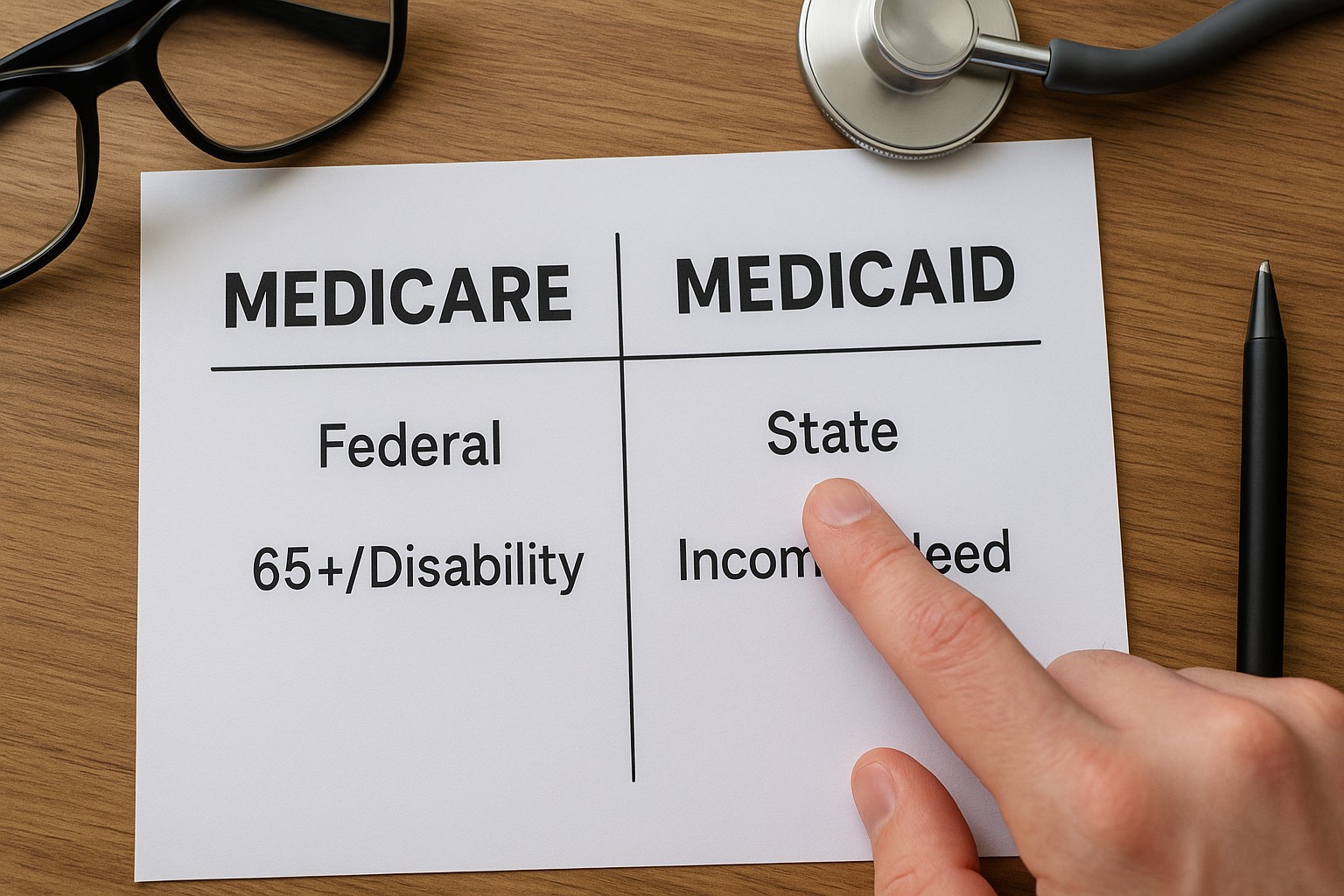
If you’ve ever heard someone say, “I have Medicare… or maybe Medicaid?”—you’re not alone. The names sound similar, both help with healthcare, and the paperwork can feel like a maze. But the difference between Medicare and Medicaid is actually pretty clear once you know one core idea:
- Medicare is mostly about age/disability
- Medicaid is mostly about income/need
Let’s break it down in plain English.
What is Medicare?
Medicare is a federal health insurance program. It’s generally for people who are 65 or older, and also for some younger people with certain disabilities or conditions.
What Medicare usually helps cover (high level)
Medicare is commonly connected to hospital care and medical services (like doctor visits). Many people also add prescription drug coverage and/or extra plans to help reduce out-of-pocket costs.
What is Medicaid?
Medicaid provides health coverage for people who meet income and eligibility rules, including many low-income adults, children, pregnant women, older adults, and people with disabilities.
Why Medicaid feels “different” in every state
Medicaid is run by states under federal requirements. That means eligibility rules and covered services can vary depending on where you live.
Medicare and Medicaid difference (the simplest way to remember)
When people search “medicare and medicaid difference” or “what is the difference between medicare and medicaid”, they’re usually looking for this:
- Medicare: mainly age/disability-based federal insurance
- Medicaid: mainly income/need-based state-run coverage (with federal rules)
Medicare vs Medicaid chart (quick comparison)
Here’s a simple Medicare vs Medicaid chart you can use for quick understanding:
| Feature | Medicare | Medicaid |
| Who it’s for | Mostly 65+, some people with disabilities/conditions | People with limited income/resources (rules vary by state) |
| Managed by | Federal government | States (under federal requirements) |
| Funding | Federal | State + federal |
| Costs | Often includes premiums/cost-sharing depending on coverage | Usually low cost; varies by state |
Medicare vs Medicaid eligibility: who qualifies?
This is where most confusion happens, so let’s keep it practical.
Medicare eligibility (general)
Many people qualify at 65+, and some qualify earlier due to disability or certain medical conditions.
Medicaid eligibility (general)
Medicaid depends heavily on income and state rules. Some groups are commonly covered nationwide, and states may also expand coverage to additional groups.
If you’re unsure, the best move is to check your state Medicaid program rules (because that’s where the biggest differences show up).
Can you have both? (Dual eligible explained)
Yes. People who qualify for both Medicare and Medicaid are often called “dually eligible.” In many cases:
- Medicare generally pays first for Medicare-covered services
- Medicaid may help cover remaining costs (depending on your eligibility level and state rules)
This is a big deal because it can reduce what you pay out of pocket.
“Medical vs Medicaid vs Medicare” (and “Medi-Cal”)—what people really mean
You’ll often see searches like medical vs medicaid vs medicare or medi cal vs medicare vs medicaid. Here’s the simple translation:
- Medicare = the federal program (same structure everywhere)
- Medicaid = the needs-based program (varies by state)
- Medi-Cal = California’s Medicaid program (same category as Medicaid, different name)
So when someone says “I’m on Medi-Cal,” they’re basically saying they’re on Medicaid in California.
Real-life examples (makes it stick)
Example 1:
Rita is 68 and retired. She qualifies for Medicare because of her age.
Example 2:
Sam is 32, works part-time, and has a limited income. He may qualify for Medicaid, depending on his state’s rules.
Example 3 (both):
Mr. Khan is 70, has Medicare, and also meets his state’s Medicaid requirements. He becomes dual eligible, so Medicare usually pays first and Medicaid may help with remaining costs.
FAQ (Medicare vs Medicaid)
What’s the difference between Medicare and Medicaid?
Medicare is a federal health insurance program mainly tied to age/disability. Medicaid is a needs-based program run by states (under federal rules) for people with limited income/resources.
What are the differences between Medicaid and Medicare in cost?
Medicaid often has very low costs, while Medicare commonly involves premiums and cost-sharing depending on the plan and coverage type. Medicaid costs and benefits can vary by state.
Medicare or Medicaid difference: which one should I apply for?
If you’re 65+ (or qualify through disability/conditions), start by checking Medicare. If your income/resources are limited, check Medicaid through your state. Some people qualify for both.
Is “Medi-Cal” the same as Medicaid?
In California, yes—Medi-Cal is California’s Medicaid program.
Conclusion
If you remember just one thing about the medicare vs medicaid difference, make it this: Medicare is mainly age/disability-based federal insurance, while Medicaid is a state-run, needs-based program for people with limited income/resources. And if you qualify for both, you may be dual eligible, where Medicare typically pays first and Medicaid can help reduce out-of-pocket costs.
Leave a Comment